
Legislative Constraints on the Power of the Purse
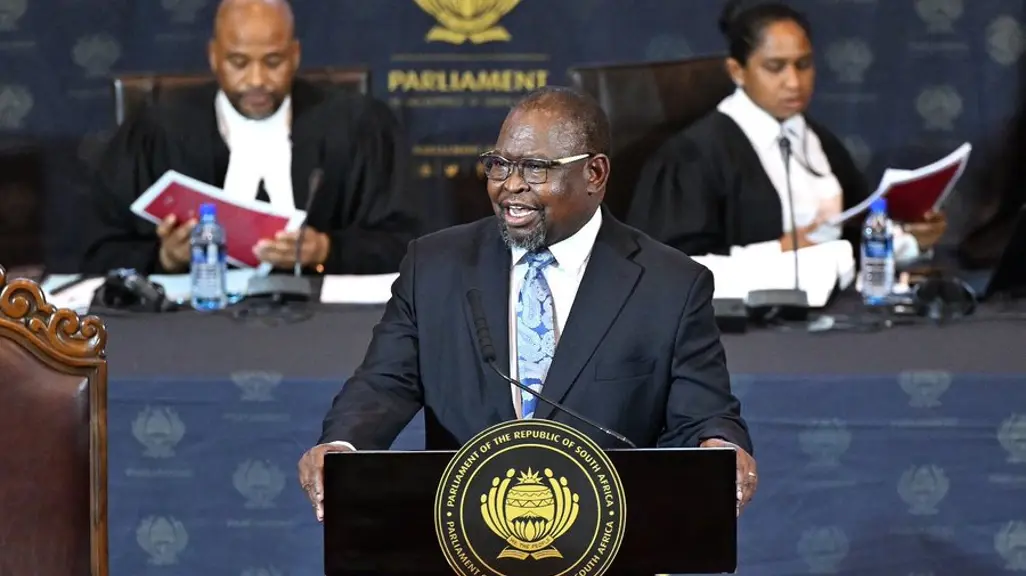
Finance Minister, Enoch Godongwana, finally tabled the national budget for the current fiscal year on 12 March 2025. This after tabling was postponed on 19 February due to a lack of consensus among Cabinet ministers in the GNU. Unfortunately the Minister’s Budget Speech was met with protests outside Parliament and little enthusiasm within Parliament.
The historical importance of the political process which will now unfold is hard to exaggerate. In previous years, when the ANC controlled both houses, the budget prepared by the Finance Ministry sailed through Parliament. Now, for the first time since 1994, it is not a foregone conclusion that Parliamentarians will vote in its favour.
As a layperson listening to the Minister’s Budget Speech (a copy of which is available on Treasury’s website), a couple of observations spring to mind, in addition to respect for the complexity of the task that we entrust every year to Finance Ministry:
- There seem to be a number of recommendations that will affect all South Africans, other perhaps than those who are already in the highest income tax bracket or who are independently wealthy. Most publicised is a VAT increase of 0.5% in 2025, bringing the current VAT rate to 15.5%. This is coupled with a further increase of 0.5% in 2026 if insufficient revenue growth is achieved in 2025, which would raise VAT to 16% in 2026. It is unclear when the 2025 VAT increase will be effective. Also, the fact that inflation-related adjustments to personal income tax brackets are absent, resulting for the umpteenth time in bracket creep. Then also the significant increase in the carbon fuel levy which could result in higher petrol and diesel prices, despite the freeze on the current amounts we pay towards the general fuel levy, the Road Accident Fund levy and the customs and excise levy.
- There are a couple of proposals that are interesting for what they seem not to do. For instance, there is no reduction in the amounts our government spends on the public sector wage bill. This in circumstances where South Africa has one of the most expensive public sector wage bills in the world. On the contrary, government is sticking to a deal to increase state workers’ wages which will cost us an additional R23.3 billion over the next three years. Nor is it clear how government debt will stabilise at an extraordinary 76.2% of GDP in the current fiscal year, in circumstances where we will spend R389.6 billion this year on debt service costs alone, more than we spend on health, the police and basic education combined. Instead we are told that government will be looking at “alternative financing arrangements” such a credit guarantees, infrastructure bonds, and other “innovative financing instruments” in which we are assured any number of pension funds, banks, development banks and international financial institutions are keen to participate.
- There are proposals that seem a bit pie-in-the sky. These include promises to conduct spending reviews in circumstances where our government obviously spends more than it earns. The President for instance has undertaken at some point in the future to establish a committee between the Presidency and Treasury to identify waste, inefficient and underperforming programmes. It is unclear how the Finance Minister could get to a workable Budget without this information? Promises too that public infrastructure spending will amount to more than R1 trillion over the next three years, focussing on transport and logistics, energy infrastructure, and water & sanitation. No-one living in the “not very pleasing” city of Johannesburg, or any other imploding city or town, could fail to applaud such initiatives. But we know too that we have an acute shortage of engineers, many of our engineering and construction firms are in dire financial straits, and every day we read reports about the construction mafia and tender-related fraud and corruption in this sector. In these circumstances, can we really imagine the future the Minister described for us in the Budget Speech in which “commuters from areas like Mamelodi, Kwa-Mashu, Motherwell and Khayelitsha . . . catch a train every 10 minutes, to get to and from work and significantly reduce the money that low-income households spend on transport”?
- Then there are proposals that are conspicuous in their absence. For instance, what happened to the R3 trillion NHI and R100 billion Transformation Fund that also have to be funded by South African taxpayers? How is government assisting every second young South African who cannot find a job? Why is there no explanation for the funding gaps between this Budget and the February 19 Budget, never mind the funding gaps created by the withdrawal of billions of Dollars in aid and grants from the South African economy? How will any of these initiatives be funded now or in the future?
In these circumstances it is very difficult for the average South African to evaluate whether the Budget actually does what it is supposed to do. Many of us are left with the niggling feeling that we are being distracted from what is actually happening.
In this, our hour of need, we turn to Parliament to help to protect the rights and interests of ordinary South Africans. Mmusi Maimane of BOSA, who also chairs the Appropriations Committee, has said that Parliament should not simply rubber-stamp the Budget this time, a Budget he has characterised as being without growth, which double-taxes people for years of corruption, and which contains no cuts in expenditure.
The reality is that the process of Parliamentary oversight, legislated by the Money Bills and Related Matters Act 9 of 2009, on which our Parliamentarians are now embarking, is as complicated as it is lengthy. It is a Constitutionally mandated legal process, rooted in the doctrine of the separation of powers, designed to ensure that the legislature is able to exercise effective oversight and control over the executive. Parliament’s Finance Cluster has provided a useful explanation of the processes that the National Assembly (NA), the National Council of Provinces (NCOP) and various Parliamentary Committees will now follow in this regard over a period of approximately 3 months.
These processes will ultimately culminate in both houses of Parliament voting on the 2025 Money Bills that give effect to the proposed Budget, specifically the Appropriation Bill, the Division of Revenue Bill, and Budget-specific bills tabled by the Minister on 12 March such as the Eskom Debt Relief Amendment Bill. To recap the figures again in the context of such a vote in the NA (and in addition to the NCOP vote), a simple majority of 201 out of 400 MPs is required for these Money Bills to be enacted into law. Following the elections in May 2024, 360 of the 400 seats in the NA are held by the top 5 political parties:
- ANC: 159 seats
- DA: 87 seats
- MKP: 58 seats
- EFF: 39 seats
- IFP: 17 seats.
The Minister of Finance has therefore chosen to table the proposed Budget in circumstances where it is unclear whether any of the largest political parties, both within the GNU and the opposition benches, fully support the executive in this regard. Dr. Joe Maswanganyi of the ANC and Chairperson of the Standing Committee on Finance has for instance said that we are facing a fiscal cliff, i.e. a situation where government’s revenue decreases while its spending increases, resulting in a financial crisis. The immediate reaction from the DA is that they do not support the proposed Budget. The MKP has gone as far as to threaten to bring the South African economy to a standstill if VAT is hiked.
The stakes could not be higher. There is simply no local precedent for what would happen if the majority of Parliamentarians do not support the Finance Minister.
Most obviously, in addition to concerns about a fast-approaching fiscal cliff, there are also fears around a government shutdown, an event that occurs specifically in circumstances where the legislature does not pass key bills that fund or authorise the operations of the executive, resulting in a stop to some or all of the operations of government. According to a pamphlet prepared by Parliament in 2016, admittedly in decidedly different times, “the Budget is so important that, if Parliament rejects the Budget, the Government will usually resign and an election will be held to elect a new Government.”
So please do have your say on how our government exercises the Power of the Purse in these historic times. There are public consultation processes mandated by the Money Bills Act which we understand are being arranged in several provinces around the country for the 1st and 2nd of April 2025. The different political parties are also sure to organise any number of initiatives ahead of the Parliamentary vote. In the words of Maimane, “I assure you as the people of South Africa, this is the moment where we test our democratic principles, our law-making process, to say you have to have your voice heard in what happens in the Budget”.