
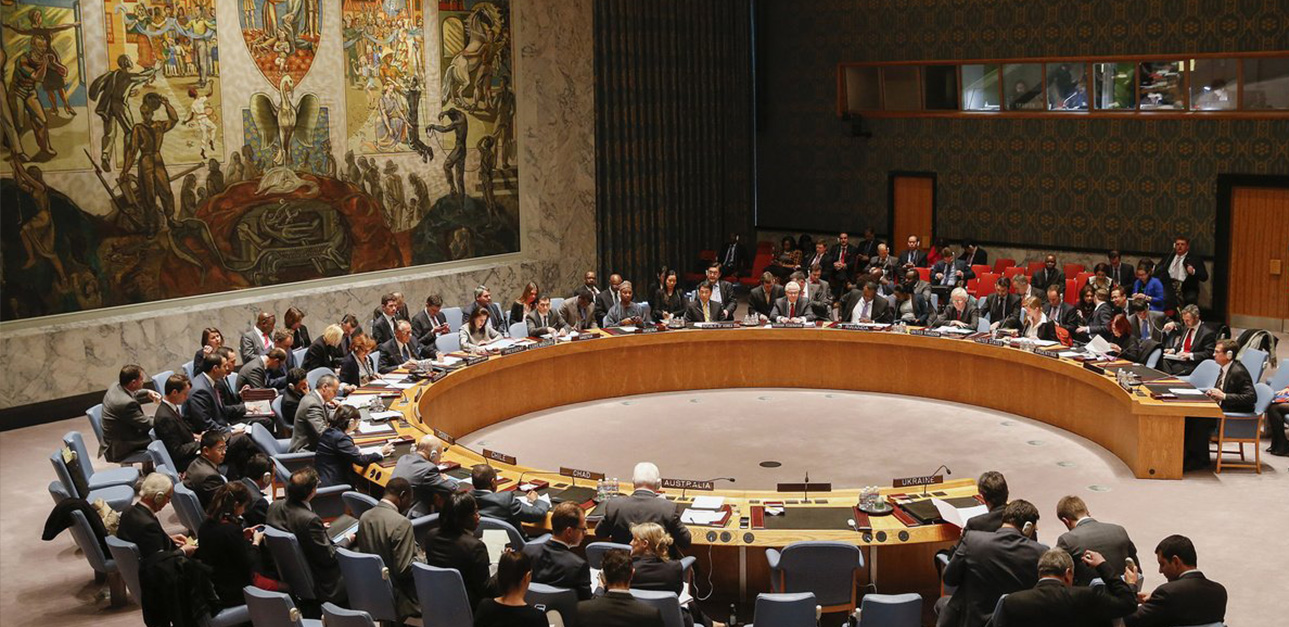
Just as it did 8 years ago following the annexation of Crimea, on 25 February 2022, the day after it invaded Ukraine, Russia used its veto in the UN Security Council to block a resolution calling for its unconditional withdrawal from the country. Simultaneously it blocked the ability of the Security Council to impose sanctions. In the same manner, Russia could use its veto power to block any resolution of the Security Council recommending its removal as a Member of the council or the General Assembly. The conflict in Ukraine therefore has demonstrated once again how the veto power of its 5 permanent members (China, France, Russia, UK and US) can impede the council’s ability to fulfil its core mission: that of preventing threats to peace, suppressing acts of aggression, and bringing about the peaceful settlement of international disputes.
Faced with paralysis in the Security Council on the issue of Ukraine, the UN General Assembly intervened by taking some extraordinary and unprecedented steps. On April 7, it voted in favour of removing Russia from UN Human Rights Council. And then, on April 26, it adopted the resolution on the “Standing Mandate for a General Assembly Debate when a Veto is Cast in the Security Council” (A/RES/76/262) (Tell Us Why Resolution).
In so doing the General Assembly has decided that its President must convene a formal meeting of the 193-member General Assembly within 10 working days of the casting of a veto by one or more permanent members of the Security Council and hold a debate on the situation on which the veto was cast, provided that the General Assembly does not meet in an emergency special session on the same situation. Further, the General Assembly has invited the Security Council to submit a special report on the use of the veto in question at least 72 hours before the relevant discussion is scheduled to occur.
The Tell Us Why Resolution was adopted by consensus, having been tabled by Lichtenstein and co-sponsored by 83 Member States, including France, the UK and the US as permanent members.
However, speaking in the Explanation of Position and after its adoption, delegations expressed a range of divergent views on the resolution. The representative of the Russian Federation said that, without the veto, the Security Council would simply rubber-stamp questionable decisions imposed by a nominal majority that would be hardly possible to implement. “The veto is not the problem,” he said, “rather it is the unwillingness of certain Members to listen to others and to achieve compromise, which compels use of the measure”. He rejected the attempt to create an instrument to exert pressure on the Security Council, stressing that the separation of powers between the General Assembly and the council has allowed the UN to function effectively for more than 75 years. Bolstering that point, the representative of Belarus said that, instead of trying to determine why consensus in the Security Council remains elusive, the Tell Us Why Resolution “simply relies on brute force”.
To those claims, the US delegate pointed out that Russia had repeatedly violated the UN Charter and then blocked the Security Council’s efforts to address the situation: “The veto was not intended as a carte blanche for impunity,” he said, “nor meant to confer automatic protection from accountability in perpetuity”. In a similar vein, the UK representative said that the veto power should not be used lightly or without accountability and should not prevent the Security Council from fulfilling its mandate. She pointed out that, in addition to the current instance, Russia had used the veto power 17 times since 2011 to block the Security Council’s efforts to protect the Syrian people. In such actions she said Russia stands isolated from other Members and she welcomed the call for permanent Security Council members to explain their use of the veto to the General Assembly.
READ the full Meetings Coverage and Press Release here.